

Queensland University of Technology (QUT) needed to upgrade their atmospheric research capabilities at the International Laboratory for Air Quality & Health (ILaQH). A returning Biora customer, QUT required a sophisticated facility to study air quality and atmospheric chemistry with precision and safety.
Considerations
QUT’s existing setup consisted of a plastic bag mounted over a commercial air conditioning unit, which limited their research potential:
- Temperature instability: The commercial AC unit couldn’t maintain consistent temperatures, with fluctuations that made data unreliable
- No environmental control: Lack of proper air circulation created inconsistent conditions across the experimental space
- Safety risks: No containment systems for atmospheric gases or protection from UV radiation
- Limited monitoring: Researchers couldn’t track or control experimental conditions in real-time
These limitations meant that sophisticated atmospheric studies were simply impossible with the existing infrastructure.
The Solution
Biora managed a comprehensive transformation project, coordinating specialised third-party contractors to design and build a PC2-compliant atmospheric research chamber. The 3-4 month project delivered a facility with capabilities that exceeded QUT’s requirements.
Temperature Precision
The new chamber maintains temperatures between 10-25°C with ±0.5°C accuracy—essential for atmospheric research. This precision comes from a specialised HVAC system featuring:
- Medium-temperature evaporator
- Condenser unit
- Multiple temperature sensors throughout the system
- Custom-designed ductwork with insulation
Safety Systems
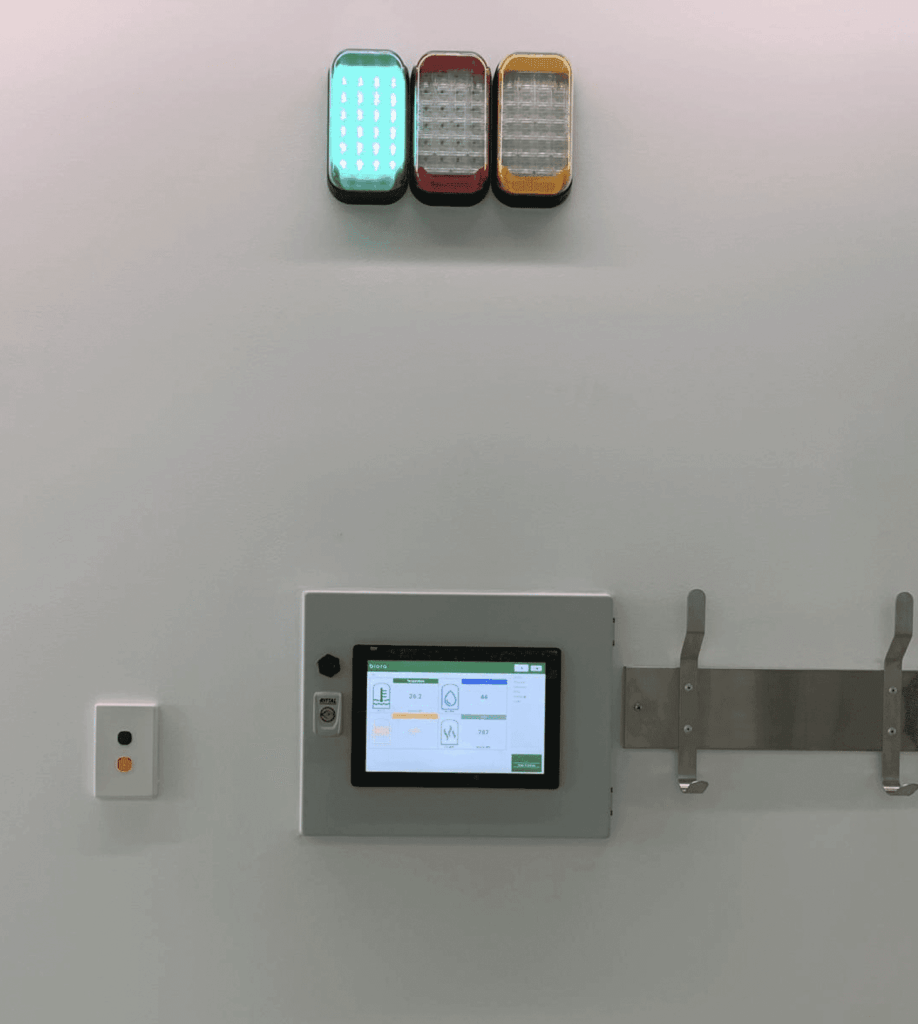
In addition to the research capabilities, comprehensive safety features were implemented to protect both researchers and experiments:
- Negative pressure prevents gas leakage
- Automated CO2 monitoring triggers exhaust systems when needed
- UV-interlocked power outlets prevent accidental exposure
- Visual status indicators (green for standby, red for UV active, amber for high CO2)
- Emergency power shutoff and 90-minute backup LED lighting
- Viewing camera to allow researchers to visually monitor the inside of the chamber while experiments are in progress
Advanced Monitoring
Thanks to Biora’s HMI, the chamber includes sophisticated environmental monitoring through:
- Wall-mounted aspirator with CO2, temperature, and humidity sensors
- 10″ HMI touchscreen controller
- MODBUS connectivity to QUT’s building management system
- USB ports for data logging
Design Features
The 2400mm high chamber incorporates cleanroom-grade construction with project-specific details throughout:
- Structure: 50mm floor insulation and 100mm ceiling insulation support consistent conditions. Chemical-resistant vinyl flooring with 150mm coved edges eliminates corners where contaminants could accumulate.
- Lighting: Ten UV lamps distributed across a 2340mm bank provide uniform exposure for photochemical studies.
- Access: Double doors (950mm active, 650mm inactive) with specialised seals maintain chamber integrity while allowing easy researcher access.
- Air Distribution: Three inline fans with Y-piece connectors ensure uniform conditions throughout the space, while manual dampers allow precise airflow adjustments.
The Results
QUT now operates a purpose-built atmospheric research chamber, enabling studies that were previously impossible. The facility’s precision and safety features have transformed their research capabilities, allowing them to:
- Conduct repeatable experiments with reliable data
- Study atmospheric processes under controlled conditions
- Meet PC2 compliance requirements for advanced research
- Collaborate on international atmospheric studies
This successful transformation demonstrates how strategic infrastructure investments can unlock research potential. By replacing makeshift equipment with purpose-built facilities, institutions can advance from basic studies to world-class research.
The project showcases Biora’s ability to design, engineer and project manage complex controlled environment builds, coordinating multiple contractors while ensuring all specifications meet exacting research requirements. Through careful planning and execution, what began as a plastic bag over an air conditioner became a sophisticated research facility advancing Australia’s atmospheric science capabilities.
Contact Biora to discuss how custom controlled environment chambers can transform your research facility’s capabilities and enable breakthrough discoveries.